Overview
Emergency Medicine is one of the most demanding and rapidly evolving specialties in modern healthcare. Emergency physicians are responsible for the immediate assessment, stabilization, and management of critically ill and injured patients. From trauma and cardiac emergencies to sepsis, stroke, poisoning, and respiratory failure, Emergency Medicine requires clinical precision, rapid decision-making, and strong procedural skills.
With emergency departments expanding across India, the demand for trained Emergency Medicine doctors continues to grow. For MBBS doctors, Emergency Medicine offers a highly rewarding career path with extensive hands-on exposure, diverse clinical experiences, and opportunities to make a meaningful impact on patient outcomes. The specialty develops expertise in acute care, critical thinking, resuscitation, and multidisciplinary teamwork, making it an excellent choice for doctors seeking a dynamic and future-focused clinical career.
About the Fellowship in Emergency Medicine
The Fellowship in Emergency Medicine is a 12-month program comprising 9 months of structured hybrid academic learning followed by 3 months of hands-on clinical training in partner hospitals.
Designed specifically for MBBS doctors, the program focuses on developing competence in emergency assessment, triage, trauma care, airway management, shock management, sepsis care, resuscitation, and emergency procedures. Through case-based discussions, expert-led sessions, supervised clinical exposure, and structured assessments, doctors gain the confidence and practical skills required to manage high-acuity patients in real-world emergency settings.
The program is supported by internationally recognized knowledge partners, including
-
-
-
- Royal College of Physicians of Edinburgh
- Royal College of Physicians and Surgeons of Glasgow
- Royal College of Physicians
- NHS Health Education England
- e-Learning for Healthcare (eLFH)
- eIntegrity
-
-
Doctors also benefit from training opportunities across Doctyn’ s network of 50+ hospital partner units, gaining direct exposure to busy emergency departments under the guidance of experienced emergency physicians and critical care specialists. Upon successful completion, participants are equipped with advanced clinical skills, evidence-based decision-making capabilities, and industry-recognized certification that strengthens career opportunities in Emergency Medicine.
Eligibility
- MBBS/ MD/ DNB
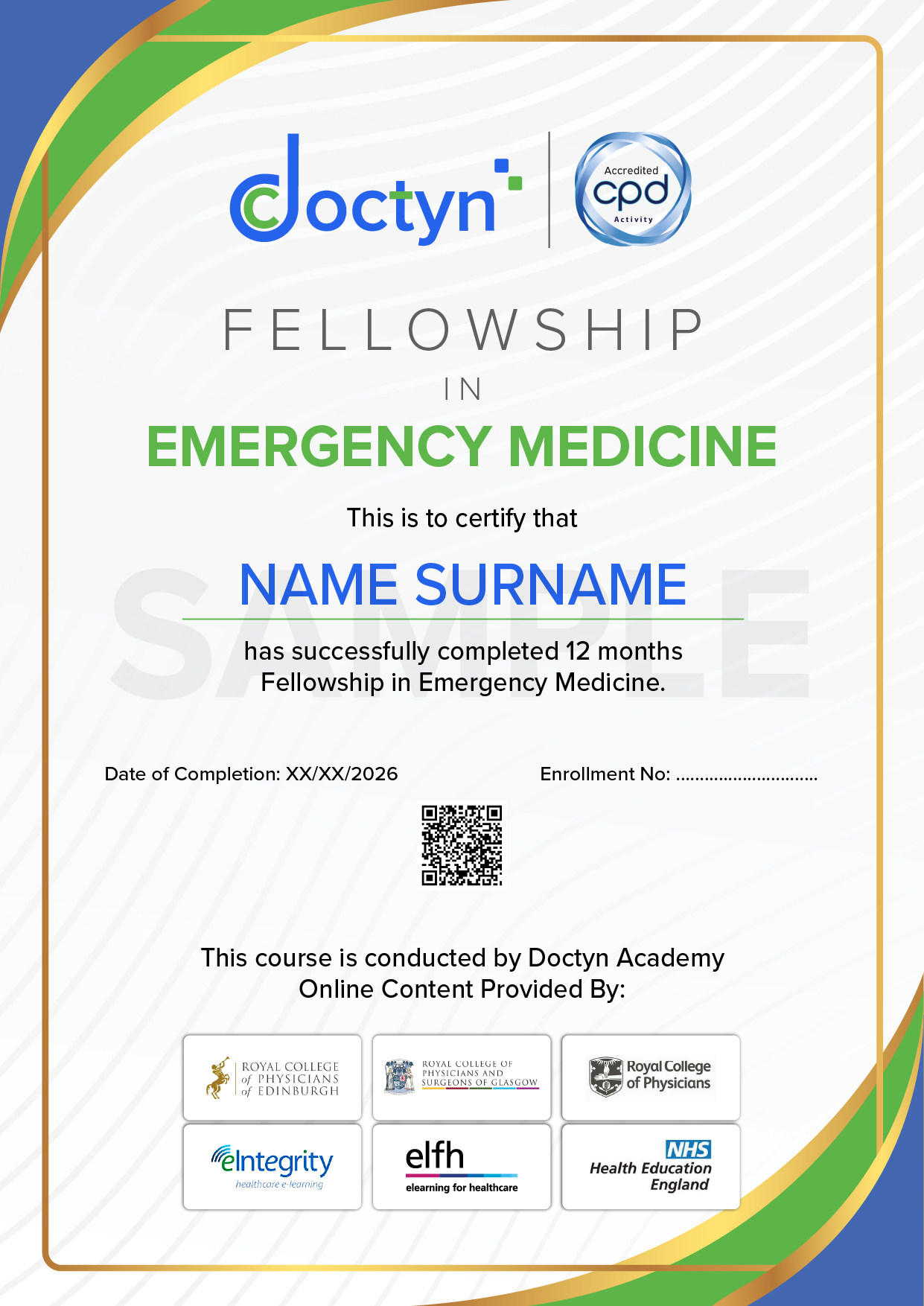
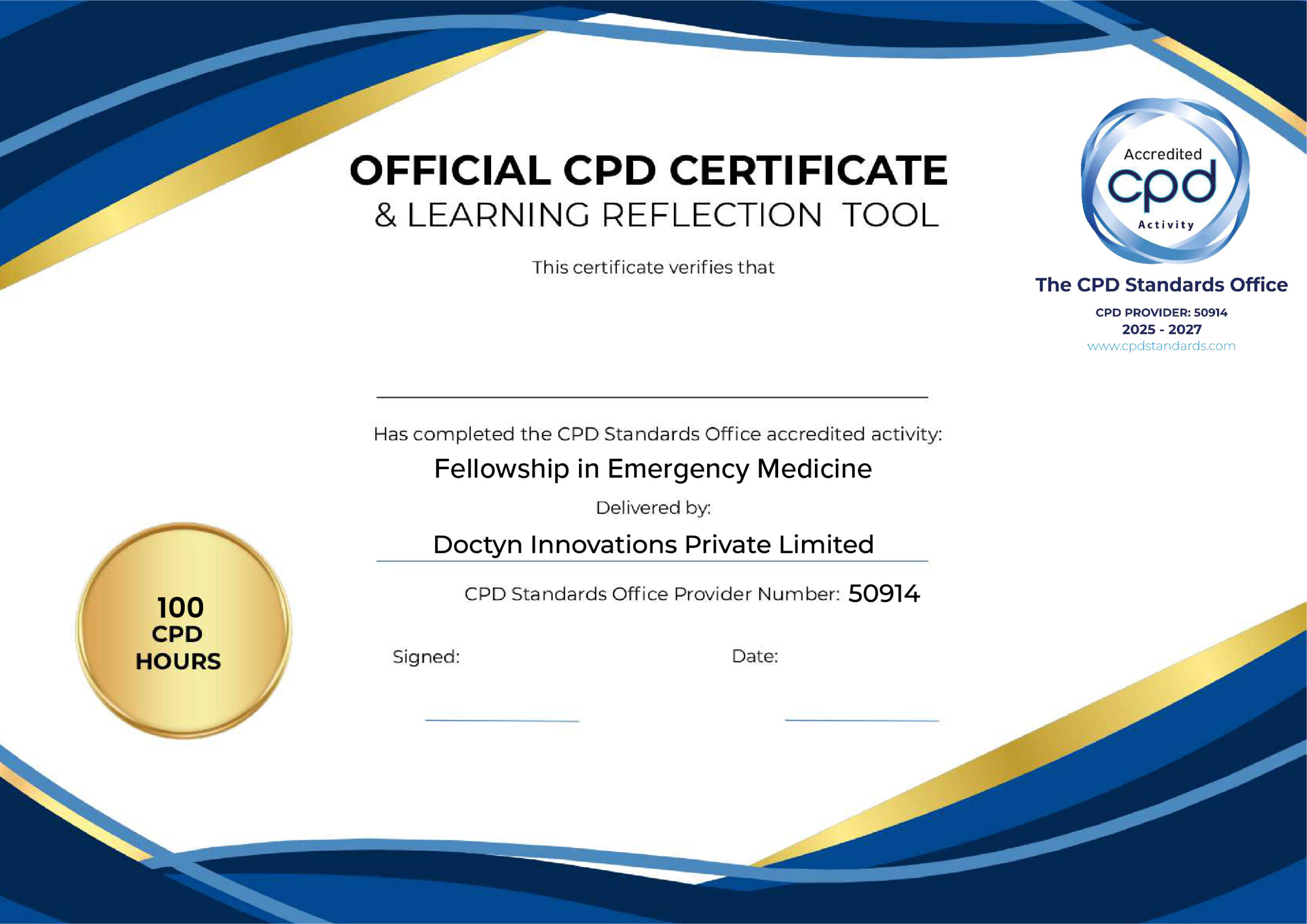
Sample Certificate
Faculty Details:
| Faculty | Details |
|---|---|
 Dr. Sateesh Kailasam
|
Designation: Emergency Medicine Specialist Specialization: Emergency Medicine, Acute & Critical Care Experience: 20+ Years Affiliation: Founder & Director – Value Med Healthcare Network Pvt. Ltd. Role in Course: Senior Faculty & Advisor |
Curriculum
Curriculum
- 21 Sections
- 115 Lessons
- 12 Weeks
Expand all sectionsCollapse all sections
- Module 1: Foundations of Emergency Medicine5
- Module 2: Initial Assessment & Stabilization (ABCDE Framework)6
- Module 3: Airway & Breathing Management8
- Module 4: Shock Management12
- 4.1Identifying shock within the first minute
- 4.2Classification: hypovolemic, cardiogenic, obstructive, distributive
- 4.3Perfusion assessment (lactate, capillary refill, mental status)
- 4.4Fluid responsiveness: PLR test, IVC ultrasound
- 4.5Early fluid resuscitation principles
- 4.6Vasopressor and inotrope initiation
- 4.7Hemodynamic support escalation
- 4.8Shock algorithms and decision pathways
- 4.9Hands-On Skills: Peripheral IV access in unstable patients
- 4.10Central venous catheter insertion
- 4.11Arterial line insertion
- 4.12POCUS for shock (cardiac function, tamponade, IVC, pneumothorax)
- Module 5: Sepsis Management7
- 5.1Early recognition of sepsis & septic shock – Sepsis screening tools
- 5.2“Golden Hour” sepsis bundles: Blood cultures, Blood cultures, Fluids, Lactate measurement
- 5.3Vasopressor initiation in sepsis
- 5.4Source control principles
- 5.5Monitoring and escalation
- 5.6Management in special populations (elderly, immunocompromised)
- 5.7Hands-On Skills: 1)Blood culture collection 2) IV & central access 3) Sepsis-based fluid administration 4) POCUS to identify sources of infection
- Module 6: Cardiovascular Emergencies6
- Module 7: Trauma & ATLS7
- Module 8: Orthopaedic Emergencies3
- Module 9: Wound Care & Minor ER Procedures6
- Module 10: Procedural Sedation & Analgesia3
- Module 11: Neurological Emergencies5
- Module 12: Toxicology & Poisoning5
- Module 13: Paediatric Emergencies5
- Module 14: Obstetric & Gynaecological Emergencies5
- Module 15: Ophthalmic & ENT Emergencies4
- Module 16: Infectious Disease Emergencies5
- Module 17: Psychiatric Emergencies4
- Module 18: Point-of-Care Ultrasound (POCUS)5
- Module 19: Emergency Pharmacology5
- Module 20: ER Documentation, MLC & Systems5
- Module 21: Case Discussions & Logbook4
FAQs
The minimum eligibility for this course is MBBS with valid MCI/NMC registration. The program is also open to MD, DNB, MS, and FMGE graduates.
You can visit the course page to fill your details, or you can click here to enroll now and submit your details to enquire about this course.
Doctyn Academy provides a flexible learning experience with a combination of self-paced topics and live lectures. To access the course materials, simply log in to our Learning Management System (LMS). Once logged in, you will be guided through the process and given access to the relevant resources, including self-paced modules and information about upcoming live lectures. Enjoy the convenience of learning at your own pace while also benefiting from interactive live sessions
Doctyn Academy’s clinical training is an integral component of our fellowship program. It provides valuable hands-on experience in a hospital environment under experienced and specialized medical faculty, allowing students to actively participate in patient care decision-making, gain proficiency in using medical equipment, and learn by training with and assisting experienced doctors in performing various procedures.
Here are the key assessments and guidelines for the Doctyn Academy program:
1.Flexible online quiz will be conducted after each module that helps the students in self-evaluation and improvement upon completion of all modules.
2.Flexible online examination will be conducted after each course for self-assessment. To pass the assessment, students must achieve a minimum score of 50%. This ensures a satisfactory level of understanding and proficiency in the subject matter
3.Fellowship students must complete all quizzes, online exams, and viva before going for clinical observerships.
4.To receive the final certification from Doctyn Academy, students participating in clinical observerships must successfully complete the observership according to the guidelines set by the hospital. Once the observership is completed, students are required to share the certificate of completion with Doctyn Academy as proof, enabling the issuance of the final certification. Upon successful completion of all requirements, Doctyn Academy will award a certificate.
5.Three attempts are allowed for each online exam without charges. Additional attempts will incur examination fees.
This program is supported by international accreditation partners such as the Royal College of Physicians of Edinburgh, Royal College of Physicians and Surgeons of Glasgow,
Royal College of Physicians, NHS Health Education England, e-Learning for Healthcare (ELFH) and eIntegrity with digital content provided by them, as detailed in the brochure.
It is designed to enhance your clinical knowledge and provide insights into global best practices, supporting continuous professional development and hands-on experience that hospitals value. While not a formal specialist qualification, it complements medical education and aligns with professional standards in India, though it is not listed with the National Medical Council (NMC).
Our courses are accessible on Windows 7.0 or above and Mac OS X10.15 and above, using any web browser, with a minimum requirement of 1 GB RAM. For optimal performance, we recommend a minimum internet connection speed of 10 Mbps and a RAM capacity of 2 GB
Upon successful completion of the course, an electronic certificate bearing a unique enrollment ID will be issued and sent to the registered email address within 24 hours.
Additionally, upon request, a framed physical certificate can be dispatched to the provided postal address as a tangible acknowledgment of achievement. Please note that applicable charges must be paid in advance to process and fulfill the framed certificate request.
While Doctyn Academy does not offer a placement guarantee, we offer a career guidance lecture designed to assist students in making informed decisions and navigating their career paths successfully.
We offer a free cancellation policy that allows for a full refund within 7 days of enrollment if you are not satisfied with the course curriculum or content. However, please note that refunds will not be permitted after this 7-day period has lapsed.
Doctyn supports career advancement and upskilling of medical professionals by providing practical clinical exposure, and learning through innovative teaching and strong professional networking.

Dr. Smitha
The clinical training exceeded my expectations. Expert faculty and hands-on learning helped me strengthen my practical skills and confidence. A valuable step forward in my medical career.

Dr. Subhash Chandra