
Five years after COVID-19 exposed the fault lines in India’s critical care system, the country is still short of the beds, the specialists, and the nurses it needs to reliably treat its sickest patients.
But the shape of the crisis has changed.
In 2020–21, the story was absolute scarcity Delhi hospitals down to 100 unoccupied ICU beds for a city of 16 million, and physicians publicly warning that India would need hundreds of thousands of additional beds and staff within weeks.
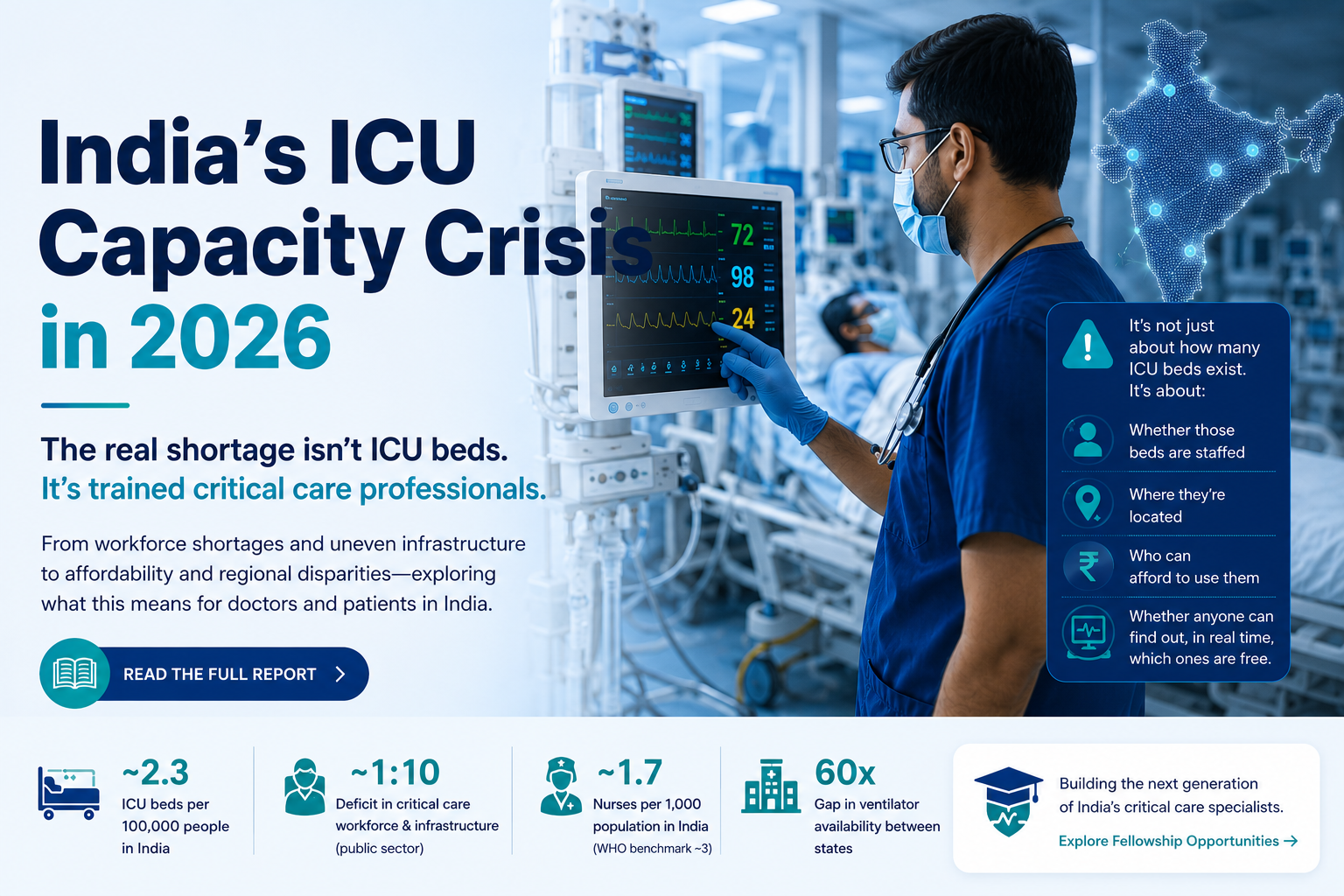
In 2026, the story is subtler, and in some ways harder to fix. It’s no longer just about how many ICU beds exist on paper. It’s about:
- Whether those beds are actually staffed
- Where they’re located
- Who can afford to use them
- Whether anyone can find out, in real time, which ones are free
This piece pulls together the current data on India’s critical care capacity, the workforce and cost pressures behind it, and what it all means day to day for the doctors running the system and the patients depending on it.
1. The numbers, in context
India has an estimated 2.3 ICU beds per 100,000 people. That figure is itself contested most national estimates are built from modeling assumptions, not an actual count of every ICU bed in the country but even generous interpretations put India well behind regional peers.
Region / Country | ICU beds per 100,000 |
|---|---|
India | ~2.3 |
Asia (23-ICU cross-sectional average) | ~3.6 |
Germany (post-pandemic surge) | 40,000+ beds added within weeks |
Italy | ~12.5 |
In absolute numbers, one detailed needs-assessment study of India’s public and private critical care sector put the country’s total ICU bed count at roughly 30,000 beds about 3.7% of all acute hospital beds nationwide. Against a population of over 1.4 billion, that’s a thin margin.
It sits on top of an already low base:
- ~0.6 hospital beds per 1,000 population overall
- Public health spending around 1.84% of GDP
Both figures trail far behind comparable middle-income countries. Health economists have increasingly argued that pouring money into new construction alone is slow, expensive, and doesn’t address the real problem which lies elsewhere.
2. The real bottleneck: staffed beds, not built beds
A 2026 analysis in the International Journal of Community Medicine and Public Health makes the point directly: the binding constraint on India’s hospital capacity isn’t the total bed count it’s the number of beds that are actually staffed, with a doctor and nurse available to run them.
The same research found utilization is wildly uneven:
- Occupancy around 50% at some facilities
- Occupancy 70–80% at busier district and tertiary hospitals
In practice, that means patients are turned away or left waiting in corridors and ambulances at overcrowded centers while beds a short distance away sit empty. Not because the beds don’t exist. Because nobody looking for a bed can see, in real time, that they do.
This “phantom capacity” problem was on full display during COVID-19: Delhi’s own bed-tracking app often showed availability that didn’t match what families found when they physically reached hospital gates, because facilities weren’t updating status in real time. Five years later, that basic information gap which hospital actually has an open, staffed ICU bed right now still isn’t solved nationally, even though the underlying digital tools (health IDs, hospital information systems, telemedicine networks) have grown enormously since.
3. The workforce shortfall: how deep does it go?
Behind the bed-utilization problem is a genuine, measurable shortage of trained people.
The headline gaps:
- ~1:10 deficit in critical care workforce and infrastructure relative to actual need (public sector)
- Critical care specialists make up only about 1:75 of the medical specialty pool
- The Indian Society of Critical Care Medicine (ISCCM), founded in 1992, has only around 12,000 registered members nationally and it’s unclear how many have completed formal intensive care training versus simply holding membership
And it’s badly distributed:
- Maharashtra alone accounts for nearly 3,000 ISCCM members; many other states have fewer than 50
- Maharashtra also has the country’s highest annual intake of DM (Doctorate of Medicine) seats in critical care medicine; several other states offer negligible training capacity
- Public-sector ventilator availability per capita: roughly 0.0002% in Bihar vs. 0.012% in Lakshadweep a roughly sixtyfold gap between states
Training pipelines remain narrow. The National Board of Examinations launched a two-year Fellowship (FNB) in critical care in 2009, upgraded to a three-year DrNB super-specialty degree in 2019 to match the DM track. But DM seats cluster in academic/public university hospitals, while FNB/DrNB seats cluster in private institutions so the pathway into critical care mirrors the public-private divide running through the rest of the system.
Nursing has it worse. WHO recommends a 1:1 nurse-to-patient ratio in critical care and 1:4 in general wards. In practice, Indian nurses often manage far more some reports cite 10–20 patients at a time in general wards. Nationally:
- ~1.7 nurses per 1,000 population, vs. a WHO benchmark of ~3 per 1,000
- ~1 doctor per 1,404 people, vs. the WHO’s recommended 1:1,000
Both gaps are compounded by emigration. Skilled nurses continue leaving for the US, UK, Canada, and the Gulf for better pay and conditions which is also why ICU/OT nursing has become one of the highest-paid nursing specializations within India, precisely because trained specialists are so scarce domestically. Physician emigration follows a similar, somewhat counterintuitive pattern: studies tracking Indian medical graduates found those trained at the country’s top-ranked colleges were 2 to 4 times more likely to emigrate to the US or UK than graduates of lower-ranked institutions so the loss is concentrated disproportionately among the most highly trained doctors the system produces
4. What ICU care actually costs and who can't afford it
For patients, all of the above eventually collapses into one blunt question: can we afford this? For a large share of Indian households, the honest answer is often no.
Private hospital ICU costs (per day):
Care level | Cost |
|---|---|
Standard ICU stay | ₹15,000 – ₹30,000/day (~US$180–360) |
With ventilator / advanced life support | ₹25,000 – ₹50,000+/day |
Full critical admission (surgery + ventilation + extended stay) | ₹4.5 lakh – ₹30 lakh+ total |
Intensive care alone is estimated to account for 20–30% of total hospitalization costs for a typical critical admission often the single line item that determines whether a family emerges from a medical crisis financially intact or in debt for years.
Government hospitals are a different world. One detailed costing study at AIIMS Bhubaneswar a public teaching hospital serving mostly lower-income patients found the actual daily cost of running a surgical ICU bed at about ₹11,241 (~US$155), of which patients were charged a token ₹35 per day, the rest absorbed by the public system. Broader estimates of full government ICU admissions (with complications) range from roughly ₹60,000 to ₹3 lakh still a fraction of private-sector rates, but non-trivial for households near the poverty line. The trade-off: higher patient loads, longer waits, and less certainty a bed will be available exactly when needed.
Insurance has narrowed the gap, not closed it. Ayushman Bharat PM-JAY, India’s flagship scheme, now offers free hospitalization cover up to ₹5 lakh per family and, by mid-2026, had issued over 44 crore health cards and financed more than 12 crore hospitalizations worth roughly ₹1.8 lakh crore. It was expanded in October 2024 to cover all senior citizens above 70, regardless of income. But that ₹5 lakh cap can be exhausted quickly by a single prolonged ICU stay at private-sector rates so insurance has narrowed the affordability barrier, not eliminated it.
5. Why this matters for doctors
- Chronic overload for available staff. With critical care specialists making up roughly 1 in 75 of the specialist workforce, and intensivists concentrated in a handful of states and metros, doctors and nurses outside those hubs routinely manage patient loads well beyond WHO ratios especially in public hospitals.
- The open-ICU model still dominates. Unlike the closed/semi-closed staffing models common in the US and UK where a dedicated intensivist team holds primary responsibility for every patient most Indian ICUs run on an open model, where admitting physicians from multiple specialties retain responsibility for their own patients within a shared unit. That shapes how care is coordinated and who’s ultimately accountable for a given decision.
- Training bottlenecks shape careers. With DM seats clustered in a few public academic centers and FNB/DrNB seats clustered in private institutions, a young doctor’s route into critical care and the mentorship and career trajectory that comes with it depends heavily on where and in which state they trained.
- Two very different practice realities. A public-hospital doctor works within near-free care but constrained staffing and equipment; a private-hospital colleague has better ratios and equipment but operates under commercial pressure, in a largely unregulated cost environment. Doctors moving between or referring across these systems are effectively working across two different resource universes within one country.
- Emigration is a live retention problem. Because doctors from India’s top-ranked colleges are most likely to emigrate, the loss isn’t randomly distributed it disproportionately removes exactly the cohort critical care needs most to lead training and mentorship at home.
6. Why this matters for patients
- Geography is often destiny. ICU beds, ventilators, and intensivists cluster in urban centers and a handful of states, so rural and semi-urban patients often face long transfers sometimes past the window in which transfer is medically safe. In many district headquarters, the local district hospital is the only facility offering any critical care at all. Any disruption to that single hospital say, its designation as a dedicated pandemic facility, as happened widely during COVID-19 can knock out essential services like institutional deliveries, dialysis, and chemotherapy for an entire district, not just infectious-disease patients.
- The bill can be the difference between recovery and ruin. With private ICU stays capable of running into the tens of lakhs of rupees, families often choose where to seek care based on what they can afford as much as what’s medically optimal. PM-JAY has genuinely helped, but its ₹5 lakh cap doesn’t stretch far against private-sector pricing for a serious, prolonged admission.
- Nobody can reliably tell you where an open bed is. With no functioning national real-time tracker for staffed availability, families, ambulance crews, and referring doctors are often working from outdated or incomplete information the same dynamic that caused so much visible suffering during India’s COVID-19 waves.
- Care quality varies sharply by which system you can access. Private-facility patients typically get shorter waits, richer staffing ratios, and more advanced equipment. Public-system patients may see equally skilled physicians institutions like AIIMS are widely regarded as centers of clinical excellence but often after longer delays and under heavier per-staff patient loads.
7. What's being done: the policy response
The government’s primary vehicle for closing these gaps is the Pradhan Mantri Ayushman Bharat Health Infrastructure Mission (PM-ABHIM), launched in October 2021 with an original allocation of ₹64,180 crore running through 2025–26.
Its critical-care-relevant piece is the construction of Critical Care Hospital Blocks new 50–150 bed units sized to district population, meant to ensure every district headquarters has genuine dedicated critical care rather than relying on ad hoc transfers elsewhere during emergencies. Twelve central institutions are also getting dedicated 150-bed Critical Care Blocks, alongside a broader push to strengthen the National Centre for Disease Control and regional disease-surveillance capacity.
Budget momentum picked up in 2026:
- Union Budget 2026–27 raised PM-ABHIM’s allocation from ₹2,845 crore (FY 2025–26 revised estimates) to ₹4,770 crore a ~68% increase
- ₹4,200 crore of that is earmarked for state-level infrastructure under the centrally sponsored component
That increase followed real criticism: independent analysis found only about half of PM-ABHIM’s original total budget had actually been disbursed and utilized as the scheme approached its scheduled end date, and that it had leaned heavily toward capital expenditure buildings and equipment without robust provision for the ongoing operations and maintenance costs states will need to absorb once central funding tapers off after 2026. Because public health is constitutionally a state subject, the scheme’s success depends heavily on individual states’ capacity and willingness to execute it and eventually shoulder those recurring costs a structural risk health-policy researchers keep flagging.
Digital infrastructure is the other front and probably where the most tangible near-term gains are happening:
- eSanjeevani, the government’s telemedicine platform, calls itself the world’s largest, linking roughly 155,000 primary health and wellness centres to specialist doctors via a hub-and-spoke model. As of mid-2025 it had facilitated about 37.2 crore (372 million) remote consultations through more than 2.2 lakh registered providers. It’s not a substitute for physical ICU capacity, but it partially answers the specialist-distribution problem letting a rural patient or peripheral hospital get expert triage input without a physical transfer.
- The Ayushman Bharat Digital Mission (ABDM) has issued more than 90 crore ABHA digital health IDs, building the shared data backbone any future national bed-tracking or referral system would need. Without this kind of interoperable infrastructure, a real-time “who has a free, staffed ICU bed right now” system isn’t buildable at national scale.
- Local bed-tracking pilots already prove the concept works. Delhi’s COVID-era bed portal and a bed-management system at AIG Hospitals, Hyderabad, both showed that real-time visibility into staffed bed availability not just theoretical capacity measurably improves occupancy and throughput, with zero new beds built. Researchers have proposed scaling this into a national dashboard, arguing it’s one of the fastest, cheapest levers available relative to new construction.
8. The outlook for 2026 and beyond
India’s ICU story in 2026 comes down to three converging gaps:
- A workforce gap too few trained intensivists and critical care nurses, concentrated overwhelmingly in a small number of states and cities, thinned further by emigration that disproportionately draws from the most highly trained cohort.
- A utilization gap existing capacity poorly matched to real-time demand, because no reliable national system tracks which beds are actually staffed and available right now.
- An affordability gap private-sector ICU costs that can run into the tens of lakhs of rupees, against an insurance cap that, however transformative compared to a decade ago, still doesn’t fully close the distance for the most severe cases.
None of these has a single, simple fix and none will close through construction spending alone.
For doctors and the profession, the near-term priorities are largely about people, not buildings:
- More critical care training seats, distributed evenly across states rather than concentrated in Maharashtra and a handful of academic centers
- Stronger incentives to retain intensivists and ICU nurses in rural and semi-urban postings
- Continued work through bodies like the ISCCM toward staffing standards robust enough that “ICU bed” reliably means a bed with a properly trained team attached, wherever in India it sits
For patients, geography and financial resources will keep shaping the odds of getting timely critical care but the trend line is genuinely improving:
- PM-JAY and eSanjeevani have both made real, measurable progress narrowing that gap
- PM-ABHIM’s renewed 2026–27 budget signals more physical infrastructure is coming
- The single highest-leverage move still on the table based on evidence from Delhi’s and Hyderabad’s pilots is turning India’s already-substantial digital health backbone (ABHA IDs, hospital information systems, eSanjeevani’s referral network) into a genuine real-time, staffed-capacity visibility system
That last piece is the crux of it: a system that lets an ambulance driver, a worried family, or a referring doctor in a district hospital know, in the exact moment it matters, precisely where a functioning ICU bed actually is.
And the underlying trajectory is a hopeful one. India has closed larger gaps than this before universal vaccination reach, the world’s largest telemedicine network, a digital health ID system built in under five years. The pieces needed to fix critical care access are, for the most part, already in motion; what’s left is largely execution and time. A country that could scale eSanjeevani to 37 crore consultations and ABHA to 90 crore IDs has already shown it can move fast when it decides to. Critical care is very likely next.
For the workforce gap specifically, there’s a very direct, personal lever available to any MBBS doctor reading this: formal critical care training.
Given how thin the intensivist pool is and how concentrated it is in a few states an MBBS doctor who completes a structured critical care fellowship becomes disproportionately valuable almost anywhere in the country. Our critical care fellowship is built around exactly this gap: it takes MBBS doctors through hands-on ICU training ventilator management, hemodynamic monitoring, sepsis protocols, and the day-to-day judgment calls that separate a functioning ICU from an under-resourced one so they can walk into a district hospital, a smaller private facility, or a rural critical care unit and function as genuine ICU-ready resource from day one, not years into on-the-job learning.
That’s not a small thing for the system. Every additional MBBS doctor who becomes fellowship-trained in critical care is one more staffed bed somewhere it previously wasn’t one less patient transferred hours away for care that could have happened locally. In a system where the bottleneck is people more than buildings, that’s exactly where the leverage is.