
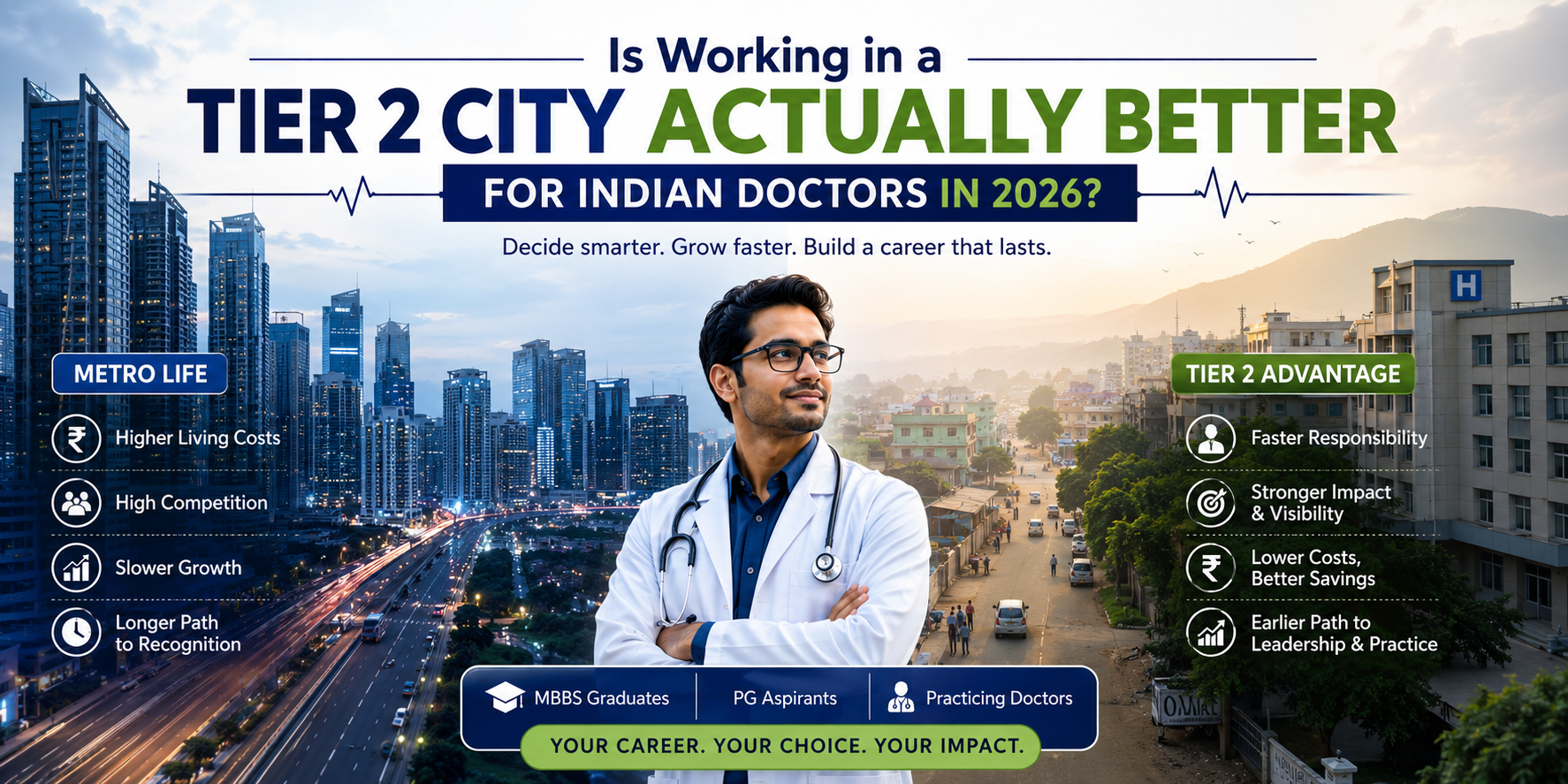
For decades, the career script for an Indian doctor was written the same way: crack NEET, get into a good MBBS college, chase a PG seat, and land up in one of India’s biggest metros, because that’s where the “real” hospitals, the “real” mentors, and the “real” money supposedly were.
In 2026, that assumption is being tested. Private hospital chains are investing heavily in cities well outside the traditional metro circuit. Diagnostic infrastructure has improved. Insurance penetration has grown. This article is written for one purpose: to help you, as a doctor, actually decide where to work next, not to convince you that Tier 2 is automatically the right answer.
Use this article as a decision tool, not a verdict. Read the sections that match your career stage and specialty, use the comparison framework to run your own numbers, and use the checklist near the end before you sign anything.
The short, honest answer: Tier 2 practice is not automatically better. It’s a strong option for doctors who want earlier responsibility, lower professional competition, and a realistic path to building a practice or a reputation, provided the specific hospital’s clinical systems are sound. The city’s population tier matters far less than the hospital’s ecosystem. That’s the filter to apply throughout this article: not “which city,” but “which hospital, for what I want next.”
Step 1: Why Tier 2 Healthcare Is Genuinely Growing
Before you weigh a move, it helps to know whether the growth story is real or just a recruiting pitch. The data says it’s real.
CRISIL Ratings, which tracks the hospital sector closely, expects private hospitals to grow revenue 14 to 15% in fiscal 2027, supported by healthy occupancy and ongoing bed additions, marking a fifth consecutive year of double digit growth. Even as growth moderates from the previous year’s peak, the hospital sector is still projected to post 10 to 12% revenue growth this fiscal and the next, driven by improving occupancy and a rising share of complex procedures, many of which are increasingly performed outside flagship metro hospitals.
Government data backs this with hard numbers. Tier 2 cities are expected to add 40 million people by FY27, and, according to one industry brokerage cited in recent reporting, more than 70% of hospitals empanelled under the Ayushman Bharat scheme are located in Tier 2 and Tier 3 cities, giving corporate hospital chains a steady, insured patient base to build around. At a population level, nearly 65% of India’s population lives in Tier 2, Tier 3 cities, and rural regions, yet access to tertiary and quaternary healthcare remains disproportionately concentrated in metros.
What this means for your decision: the demand and the capital are both real. That takes “will there even be a job” off the table for most specialties. It does not answer whether a specific job is a good one. That’s what the rest of this article helps you check.
Step 3: Understand Career Leverage, the Factor Most Doctors Skip
This is the part of the decision most doctors underweight, and it matters more than salary or lifestyle.
In a saturated metro ecosystem, a doctor is often one of many: one emergency physician among twenty, one intensivist among fifteen, one general physician among thirty, all competing for the same procedures, referrals, and visibility. In a growing Tier 2 hospital, the same doctor may instead help establish clinical protocols from scratch, lead a unit or department, train junior doctors, sit in on recruitment and hospital planning decisions, become the hospital’s visible specialist, and build direct referral relationships years earlier than a metro career path would allow.
Ask yourself: do you currently have a clear path to any of that where you are? If not, that’s a concrete reason to evaluate a Tier 2 offer seriously, not just a lifestyle upgrade to weigh against a pay cut.
If You're an Early Career MBBS Doctor: NEET PG Credits Change the Math
If you’re deciding where to work right after MBBS, there’s a concrete, quantifiable form of career leverage worth factoring in directly: NEET PG incentive marks for government service in rural, remote, or difficult areas.
Many states that run their own NEET PG counselling for state quota and government medical college seats award bonus marks on top of your NEET PG score for time served as a government Medical Officer in underserved postings. A model used in some form by several states categorizes postings into four tiers, each carrying different weightage:
- Difficult hill areas: up to 10% incentive
- Difficult plain areas: up to 9% incentive
- Remote areas: up to 8% incentive
- Rural areas: up to 5% incentive
These marks are typically calculated based on completed years or months of service verified against official records, and are capped at a maximum of 30% under MCI and NMC regulations. Incomplete or fractional service periods generally don’t count, so the marks only accrue for genuinely completed time. Exact percentages and area classifications differ by state, so check your own state’s current notification before you commit.
There’s also movement to formalize this nationally: a Parliamentary Standing Committee has recommended a combined package of financial, academic, and professional incentives, including additional NEET PG marks or reservation for rural service, to keep qualified doctors available in rural hospitals, on top of existing hard area allowances and specialist honorariums.
The trade off to weigh against this is the service bond many states attach to government PG seats: typically two to five years of mandatory service in a government hospital, often rural or underserved, after finishing PG, with monthly stipends around ₹45,000 to ₹50,000 and penalties for breaking the bond that can run into several lakhs, occasionally as high as ₹50 lakh, depending on the state. Some states have dropped mandatory bonds; others still enforce them.
The decision this leads to: if you’re weighing a rural or Tier 2 government posting right after MBBS, don’t treat it as a stopgap. Model it as a scoring strategy for your next NEET PG attempt, weighed against the bond commitment you’d be taking on. That’s a calculation worth doing on paper, with your specific state’s rules, before you accept or decline a posting.
Step 4: Check Whether "More Responsibility" Actually Means "Better Training"
This is where it’s easy to talk yourself into a bad decision. Earlier responsibility in a smaller hospital can mean broader case exposure and faster decision making confidence. It can also mean something worse: independence without supervision.
The same conditions that create “faster responsibility,” namely fewer doctors and leaner departments, can also mean weaker escalation protocols when a patient deteriorates, limited specialist backup for complications, inconsistent documentation and case review systems, and thinner nursing and diagnostic support. This pattern shows up in hospital staffing reporting across many parts of the country: smaller public hospitals with vacant specialist posts, and busy referral hospitals having to actively manage incoming ICU referrals because demand has outpaced capacity. It’s a general pattern, not tied to any one place, and it shows up wherever hospital growth outpaces staffing.
Before you accept a role built around “you’ll get more responsibility here,” verify who actually supervises you, whether escalation protocols exist on paper, and what happens on the night something goes wrong. That single check tells you more than the job description will.
Step 5: Match Your Specialty to Where Demand Is Strongest
Not every specialty benefits equally from a Tier 2 move. If your specialty is on this list, a Tier 2 posting is worth serious consideration:
- Family medicine and general practice. Smaller cities need doctors who can manage chronic disease, undifferentiated symptoms, preventive care, and family level continuity.
- Internal medicine. Sustained demand for physicians who can manage multiple comorbidities and coordinate inpatient and outpatient care.
- Diabetes and metabolic medicine. Diabetes, hypertension, and cardiovascular risk are not metro exclusive conditions, and doctors who combine clinical care with long term follow up can build strong practices.
- Emergency medicine. Growing multispecialty hospitals need structured emergency departments, triage, and resuscitation skills.
- Critical care. Genuine demand exists, but verify nursing strength, ventilator support, and consultant backup before committing, since ICU staffing can be uneven even where equipment is present.
- Obstetrics and gynaecology. Strong demand, but safe practice depends on anaesthesia support, blood bank access, neonatal backup, and reliable emergency referral pathways.
- Paediatrics. Family trust and continuity make smaller city practice attractive, provided neonatal and emergency support are adequate.
- Radiology. Demand can be high where diagnostic capacity is limited, but workload, equipment quality, and reporting expectations vary widely, so check them before signing on.
If your specialty is highly niche, the calculation looks different. Read the next section before you decide.
Step 6: Know When a Metro Is Still the Right Call
Metros remain clearly stronger if your goals include organ transplant exposure, advanced oncology or complex congenital surgery, robotic surgery or interventional neuroradiology, high volume electrophysiology, rare disease management, formal research infrastructure with large clinical trials, international academic collaborations, or a highly specialised fellowship.
Research focused careers in particular tend to benefit from stronger institutional networks: access to established research collaborations has a measurable effect on a researcher’s later output and academic reach. If you’re aiming for a niche superspecialty, the practical path is often to train in a large centre first, then consider a Tier 2 move later once that specialised skill set is established. That’s a sequencing decision, not a permanent choice between the two paths.
Step 7: Pressure Test the Offer Against These Risks
A good decision means being honest about what won’t show up in the job offer.
Clinical isolation. Will senior help actually be reachable at 2 a.m., or only in theory?
Referral fragility. Can the hospital reliably transfer a patient who needs neurosurgery, interventional cardiology, ECMO, or complex paediatric surgery, and how far, and how fast?
Supporting workforce gaps. Your performance depends heavily on nurses, technicians, physiotherapists, pharmacists, and blood bank staff. Expensive equipment doesn’t help a patient if there isn’t enough trained staff to run it, a gap that shows up repeatedly in smaller city and rural hospital reporting across the country regardless of how much has been invested in beds and machines.
Employer concentration. In some smaller cities, only one or two hospitals may offer roles relevant to your specialty, which quietly weakens your negotiating power and mobility compared to a metro market with many employers.
Professional stagnation risk. Confidence can grow while learning stalls if there are no case reviews, audits, journal clubs, visiting faculty, or structured appraisal systems in place.
Community pressure and reduced boundaries. Higher local visibility cuts both ways. Reputation builds faster, but so does informal, constant, off the clock consultation from your own social network. Local language and community familiarity also matter more than clinical skill alone in how quickly you build patient trust.
None of these are reasons to rule out a Tier 2 posting on their own. They’re questions to get answered before you sign, not after.
Step 8: Factor In What Technology Can and Can't Fix
Telemedicine, AI assisted diagnostics, virtual multidisciplinary team discussions, remote mentoring, and online CME are increasingly connecting doctors in smaller cities to specialist knowledge that used to require a metro posting to access. Medical device makers have begun launching mobile surgical skills labs specifically designed to bring advanced, hands on surgical training directly to surgeons practising in India’s Tier 2 and Tier 3 cities, with rollout plans covering roughly ten Tier 2 cities in the first year of one such initiative.
Treat this as a genuine bridge, not a substitute. A webinar or simulation lab cannot replace supervised real procedures, functioning equipment, adequate nursing, or an accountable clinical department. If a hospital pitches its telemedicine or CME partnerships as the reason its thinner in person infrastructure won’t matter, verify the in person systems anyway. Ask what’s actually available in the building, not just what’s available on a screen.
Checklist For Your Interview
Use this as a literal checklist during your interview or offer negotiation, not just as background reading.
Clinical environment
- What is the average OPD, emergency, and inpatient volume?
- Which cases are managed locally, and which are routinely referred out?
- Is consultant coverage available around the clock?
- Are mortality and morbidity review meetings actually conducted?
Infrastructure 5. Is CT, MRI, ultrasound, and lab support available 24/7? 6. Is there a functional blood bank and a reliable ambulance or referral arrangement? 7. Are ventilators and monitors properly maintained, not just present?
Training 8. Who will actually supervise me, and how? 9. Are procedures logged, and is structured feedback provided? 10. Is there a clear progression pathway to more responsibility?
Employment 11. Is salary paid reliably and on time? What’s in the written contract? 12. How many duties are expected, and are post duty offs guaranteed? 13. Is professional indemnity covered, and are incentives defined in writing?
Long-term opportunity 14. Can I eventually run my own OPD, lead a department, or build referral relationships? Is private practice permitted? 15. What happened to the doctor who held this position before me?
That last question is often the single most revealing one in the entire process. Ask it directly, and listen closely to how the answer is delivered, not just what it says.
Deciding If Tier-2 Is For Your?
Use this as your final filter.
Lean toward Tier 2 if you want: faster clinical responsibility, lower living costs, real leadership opportunity, a quicker path to local reputation and private practice, long term community relationships, a less congested day to day life, and, if you’re early career, NEET PG incentive marks for rural or government service that genuinely improve your PG odds.
Lean toward a metro if you want: advanced super specialty training, high complexity procedures, serious research output, international academic networks, or exposure to rare, high acuity cases.
Before you decide either way:
- Run your own numbers using the career value framework in Step 2.
- Confirm your specialty is on the strong demand list in Step 5, or have a clear plan if it isn’t.
- Ask all 15 questions in Step 9, in writing where possible.
- If you’re in your early career, check your specific state’s NEET PG incentive and bond rules before committing to a posting.
The question worth asking isn’t “which city is bigger.” It’s “which hospital, at this stage of my career, will actually help me become the doctor I want to be.” Answer that question with real numbers and real answers from the hospital, and the right choice for you becomes much clearer than any general ranking of cities ever could.