Overview
Internal Medicine remains one of India’s most in-demand specialties, driven by rising chronic diseases and an ageing population. It offers strong job security, diverse career paths across hospitals, clinics, and academia, and some of the most competitive salaries for physicians. With opportunities for subspecialization, global pathways, and leadership roles, it’s a field that promises long-term growth and prestige.
About the Fellowship
This fellowship equips MBBS doctors with the essential skills to evaluate, diagnose, and manage a wide range of adult medical conditions. With a blend of online training and hands-on hospital training, it prepares you to function confidently as a hospital-ready physician.
Eligibility
- MBBS/ MD/ DNB
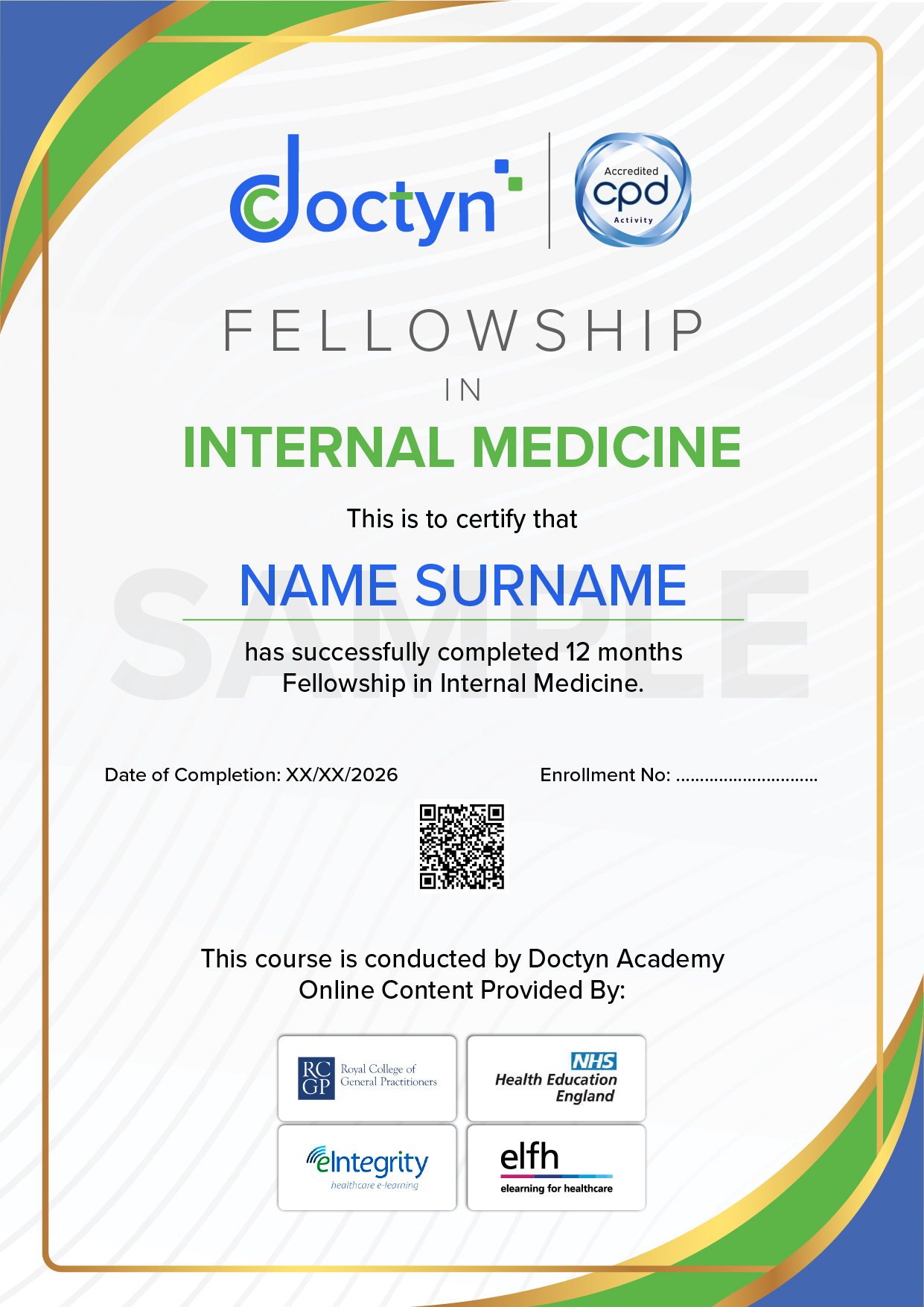
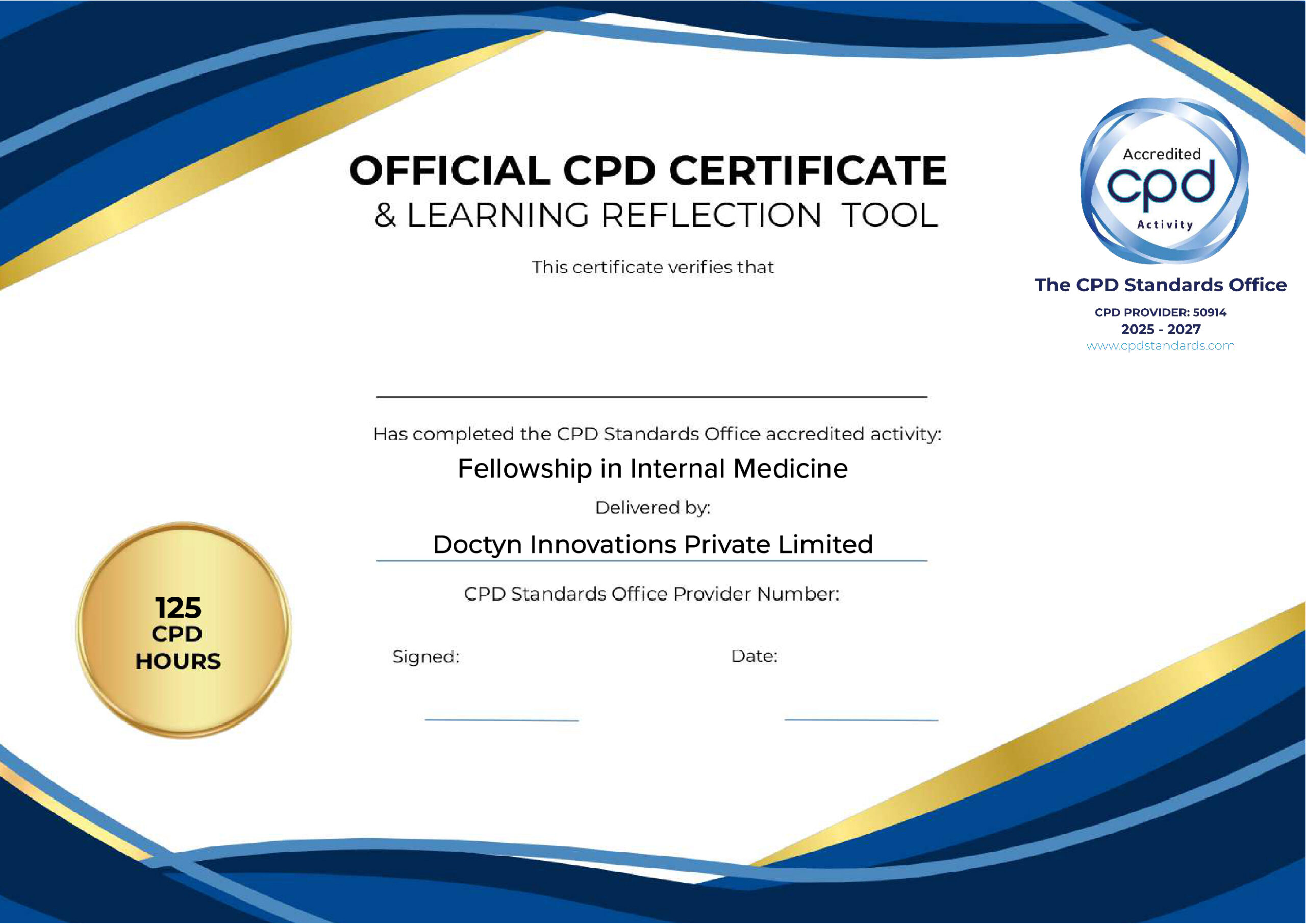
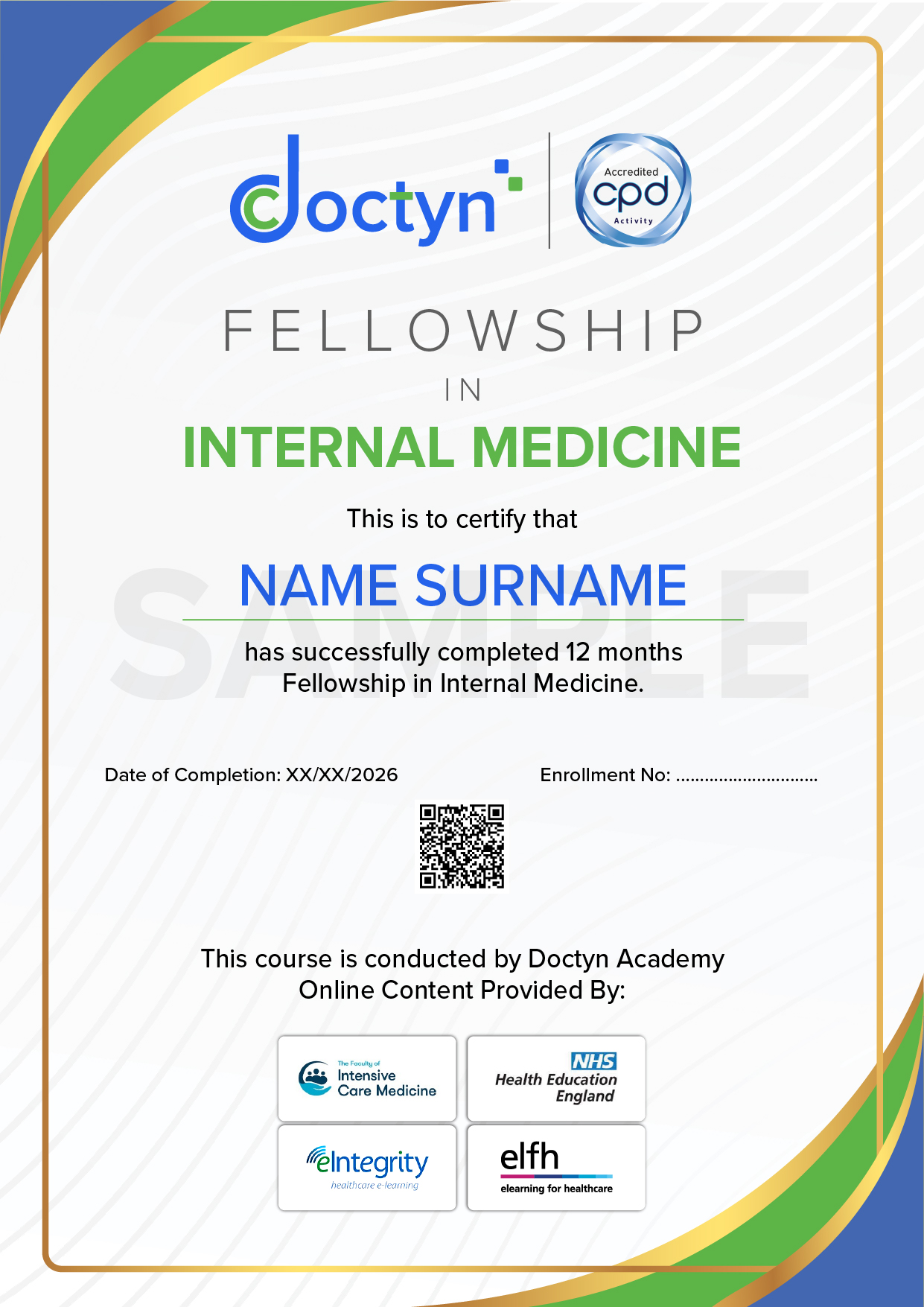
Sample Certificate
Curriculum
Curriculum
- 19 Sections
- 102 Lessons
- 12 Weeks
Expand all sectionsCollapse all sections
- Module 1: Foundations of Internal Medicine5
- Module 2: Clinical Methods & Symptom-Based Approach4
- 2.1Comprehensive history taking in adult medicine
- 2.2General examination and vital signs interpretation
- 2.3Symptom-based approach to: Fever, Chest pain, Breathlessness, Cough & hemoptysis, Edema, Abdominal pain, Jaundice, Headache, syncope, seizures, Polyuria, polydipsia, weight loss, Joint pains and backache,
- 2.4Red flag signs and when to escalate
- Module 3: Laboratory & Imaging Basics4
- Module 4: Cardiovascular System8
- 4.1Approach to chest pain, palpitations, syncope, dyspnea
- 4.2Hypertension: diagnosis, staging, treatment strategies
- 4.3Ischemic heart disease & ACS overview
- 4.4Heart failure: acute and chronic management
- 4.5Arrhythmias basics (AF, SVT, VT – recognition & first-line management)
- 4.6Valvular heart disease basics
- 4.7ECG interpretation module : Rate, rhythm, axis, intervals
- 4.8Ischemia, injury, infarction patterns, Common arrhythmias
- Module 5: Respiratory System & Critical Care Essentials7
- 5.1Approach to cough, breathlessness, wheeze, hemoptysis
- 5.2Asthma & COPD – diagnosis and long-term management
- 5.3Pneumonia, TB overview, pleural effusion
- 5.4Pulmonary embolism basics
- 5.5Oxygen therapy: modalities and indications
- 5.6Introduction to non-invasive and invasive ventilation
- 5.7Basics of ventilator modes
- Module 6: Gastroenterology & Hepatology7
- 6.1Approach to abdominal pain, dyspepsia, vomiting, diarrhea, constipation
- 6.2Acute abdomen red flags – when to involve surgery
- 6.3UGI bleed, LGI bleed – stabilization & referral
- 6.4Jaundice workup and differential diagnosis
- 6.5Chronic liver disease, cirrhosis & portal hypertension
- 6.6Hepatitis overview (A, B, C, E)
- 6.7Pancreatitis – acute and chronic basics
- Module 7: Nephrology & Electrolytes7
- 7.1Approach to edema, oliguria, hematuria, flank pain
- 7.2AKI vs CKD – diagnostic approach, staging, common causes
- 7.3Fluid therapy in medical patients
- 7.4Sodium disorders (hypo/hypernatremia)
- 7.5Potassium disorders (hypo/hyperkalemia)
- 7.6Acid-base disorders with ABG interpretation
- 7.7Indications and basics of dialysis
- Module 8: Endocrinology6
- Module 9: Haematology & Oncology Essentials6
- 9.1Approach to anaemia: microcytic, macrocytic, normocytic
- 9.2Iron deficiency, B12 deficiency, anaemia of chronic disease
- 9.3Leucocytosis, thrombocytopenia basics
- 9.4Clotting disorders & anticoagulation basics
- 9.5Red flag signs for malignancy; when to suspect cancer
- 9.6Principles of pain management and palliative care
- Module 10: Infectious Diseases & Sepsis7
- 10.1Fever evaluation (acute, subacute, chronic)
- 10.2TB overview and approach to suspected TB
- 10.3Hospital-acquired infections
- 10.4Common tropical infections: malaria, dengue, typhoid, leptospirosis, rickettsial
- 10.5Empirical antibiotic choice in common scenarios
- 10.6Sepsis and septic shock – recognition and initial management
- 10.7Infection control practices in wards & ICU
- Module 11: Neurology in Internal Medicine5
- Module 12: Rheumatology & Autoimmune Disorders4
- Module 13: Geriatric Medicine4
- Module 14: Internal Medicine Emergencies7
- 14.1Approach to the crashing patient – ABCD
- 14.2Shock (hypovolemic, septic, cardiogenic); initial management
- 14.3Hypertensive emergency & urgencies
- 14.4Acute coronary syndrome – first-hour management
- 14.5Acute severe asthma/COPD exacerbation
- 14.6UGI bleed, seizures, stroke, acute abdomen initial care
- 14.7Poisonings and envenomations – general principles
- Module 15: ICU & Step-Down Care – Essential Skills for Physicians5
- Module 16: Internal Medicine in Special Populations4
- Module 17: Preventive & Lifestyle Medicine4
- Module 18: Practical Skills During Clinical training5
- Module 19: Academic Skills & Career Building3
FAQs
The minimum eligibility for this course is MBBS with valid MCI/NMC registration. The program is also open to MD, DNB, MS, and FMGE graduates.
You can visit the course page to fill your details, or you can click here to enroll now and submit your details to enquire about this course.
Doctyn Academy provides a flexible learning experience with a combination of self-paced topics and live lectures. To access the course materials, simply log in to our Learning Management System (LMS). Once logged in, you will be guided through the process and given access to the relevant resources, including self-paced modules and information about upcoming live lectures. Enjoy the convenience of learning at your own pace while also benefiting from interactive live sessions
Doctyn Academy’s clinical training is an integral component of our fellowship program. It provides valuable hands-on experience in a hospital environment under experienced and specialized medical faculty, allowing students to actively participate in patient care decision-making, gain proficiency in using medical equipment, and learn by training with and assisting experienced doctors in performing various procedures.
Here are the key assessments and guidelines for the Doctyn Academy program:
1.Flexible online quiz will be conducted after each module that helps the students in self-evaluation and improvement upon completion of all modules.
2.Flexible online examination will be conducted after each course for self-assessment. To pass the assessment, students must achieve a minimum score of 50%. This ensures a satisfactory level of understanding and proficiency in the subject matter
3.Fellowship students must complete all quizzes, online exams, and viva before going for clinical training.
4.To receive the final certification from Doctyn Academy, students participating in clinical training must successfully complete the training according to the guidelines set by the hospital. Once the training is completed, students are required to share the certificate of completion with Doctyn Academy as proof, enabling the issuance of the final certification. Upon successful completion of all requirements, Doctyn Academy will award a certificate.
5.Three attempts are allowed for each online exam without charges. Additional attempts will incur examination fees.
This program is supported by international accreditation partners such as the eIntegrity, NHS (UK), e-Learning for Healthcare (eLfH), and the Royal College of General Practitioners (RCGP) with digital content provided by them, as detailed in the brochure.
It is designed to enhance your clinical knowledge and provide insights into global best practices, supporting continuous professional development and hands-on experience that hospitals value. While not a formal specialist qualification, it complements medical education and aligns with professional standards in India, though it is not listed with the National Medical Council (NMC).
Our courses are accessible on Windows 7.0 or above and Mac OS X10.15 and above, using any web browser, with a minimum requirement of 1 GB RAM. For optimal performance, we recommend a minimum internet connection speed of 10 Mbps and a RAM capacity of 2 GB
Upon successful completion of the course, an electronic certificate bearing a unique enrollment ID will be issued and sent to the registered email address within 24 hours.
Additionally, upon request, a framed physical certificate can be dispatched to the provided postal address as a tangible acknowledgment of achievement. Please note that applicable charges must be paid in advance to process and fulfill the framed certificate request.
While Doctyn Academy does not offer a placement guarantee, we offer a career guidance lecture designed to assist students in making informed decisions and navigating their career paths successfully.
We offer a free cancellation policy that allows for a full refund within 7 days of enrollment if you are not satisfied with the course curriculum or content. However, please note that refunds will not be permitted after this 7-day period has lapsed.
Doctyn supports career advancement and upskilling of medical professionals by providing practical clinical exposure, and learning through innovative teaching and strong professional networking.

Dr. Smitha
The clinical training exceeded my expectations. Expert faculty and hands-on learning helped me strengthen my practical skills and confidence. A valuable step forward in my medical career.

Dr. Subhash Chandra