
Overview
Overview
The Fellowship in Medicine (FM) is a 12-month career-oriented clinical training program designed to help doctors transition confidently from medical graduates to hospital-ready physicians.
Built around a structured Internal Medicine curriculum, the program combines academic excellence with practical clinical exposure to develop the knowledge, skills, and confidence required for modern hospital practice. Participants gain expertise in clinical reasoning, evidence-based diagnosis and management, emergency medicine, ECG and ABG interpretation, rational prescribing, clinical documentation, and patient communication through expert-led teaching, case-based learning, and real-world clinical experience.
To support different career goals, participants can choose between two learning pathways based on their professional aspirations.
Track 1: Fellowship in Medicine + Career Pathway at a Leading Hospital
Participants begin with 3 months of probationary clinical training at a leading Hospital, gaining real-world experience across OPDs, inpatient wards, emergency departments, HDUs, and ICUs. During this period, candidates are assessed on their clinical competence, professionalism, communication skills, and overall performance.
Eligible candidates who successfully complete the probation period and meet at a leading Hospital’s assessment criteria will be confirmed for a full-time position at a leading Hospital.
Alongside their hospital training and employment, participants complete 9 months of structured online learning, allowing them to continue developing their clinical knowledge while working.
Track 2: Fellowship in Medicine
Ideal for doctors who want to enhance their clinical knowledge and gain practical hospital exposure without opting for the employment pathway.
This pathway includes 9 months of structured online learning combined with 3 months of clinical training at a partner hospital. Participants benefit from a comprehensive Internal Medicine curriculum, expert-led teaching, case-based discussions, and hands-on clinical exposure to develop the skills and confidence required for independent hospital practice.
About the Fellowship
The transition from medical school to independent clinical practice is one of the most challenging stages in a doctor’s career. While medical graduates possess strong theoretical knowledge, many seek additional structured training to develop confidence in clinical decision-making, patient management, and day-to-day hospital practice.
The Fellowship in Medicine has been developed to bridge this gap through a structured learning pathway that combines academic training with supervised clinical exposure. The program is especially valuable for Foreign Medical Graduates (FMGs) adapting to the Indian healthcare system, as well as MBBS graduates, junior doctors, medical officers, and physicians looking to strengthen their clinical foundation.
Eligibility:
- Foreign Medical Graduates (FMGs)
Sample Certificate
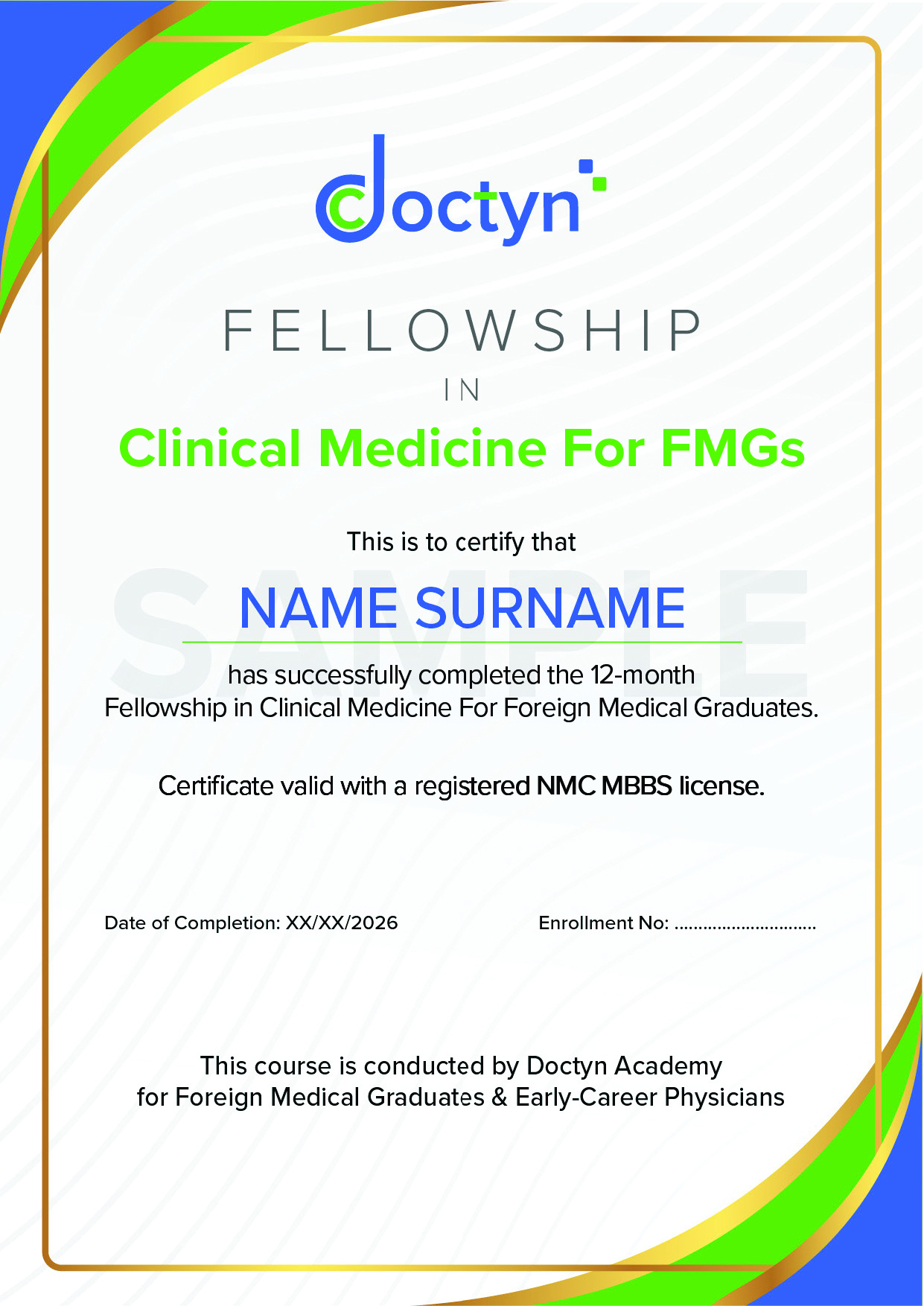
Documents Typically Required Before Interview:
- FMG Completion Certificate (from the medical college / country of passing)
- Internship Certificate (completed internship, from FMG course country or India)
Curriculum
Curriculum
- 19 Sections
- 233 Lessons
- 12 Weeks
Expand all sectionsCollapse all sections
- Module 1: Foundations of Medicine11
- 1.1Role of the physician in modern healthcare
- 1.2Principles of holistic and longitudinal care
- 1.3Evidence-based medicine and guideline-based practice
- 1.4Rational prescribing
- 1.5Antibiotic stewardship
- 1.6Clinical documentation
- 1.7Discharge summaries
- 1.8Medico-legal considerations
- 1.9Patient safety
- 1.10Ethics
- 1.11Professional communication
- Module 2: Cardiovascular Medicine22
- 2.1Approach to chest pain
- 2.2Palpitations
- 2.3Syncope
- 2.4Dyspnea
- 2.5Hypertension management
- 2.6Ischemic heart disease
- 2.7Acute coronary syndromes
- 2.8Heart failure
- 2.9Arrhythmias
- 2.10Atrial fibrillation
- 2.11Supraventricular tachycardia
- 2.12Ventricular tachycardia
- 2.13Valvular heart diseases
- 2.14Cardiovascular risk assessment
- 2.15Practical ECG interpretation including rate
- 2.16Rhythm
- 2.17Axis
- 2.18Intervals
- 2.19Ischemia
- 2.20Injury
- 2.21Infarction
- 2.22Rhythm abnormalities
- Module 3: Respiratory Medicine & Critical Care Essentials16
- 3.1Approach to cough
- 3.2Breathlessness
- 3.3Wheezing
- 3.4Hemoptysis
- 3.5Asthma
- 3.6Chronic obstructive pulmonary disease
- 3.7Pneumonia
- 3.8Tuberculosis
- 3.9Pleural effusion
- 3.10Oxygen therapy
- 3.11Respiratory failure
- 3.12Non-invasive ventilation
- 3.13Pulmonary embolism
- 3.14invasive ventilation
- 3.15ventilator modes
- 3.16Fundamentals of respiratory critical care
- Module 4: Gastroenterology & Hepatology16
- 4.1Approach to abdominal pain
- 4.2Dyspepsia
- 4.3Nausea
- 4.4Vomiting
- 4.5Diarrhea
- 4.6Constipation
- 4.7Gastrointestinal bleeding
- 4.8Acute abdomen
- 4.9Jaundice
- 4.10Liver function assessment
- 4.11Viral hepatitis
- 4.12Chronic liver disease
- 4.13Cirrhosis
- 4.14Portal hypertension
- 4.15Pancreatitis
- 4.16Referral decision-making in surgical emergencies.
- Module 5: Nephrology & Fluid-Electrolyte Disorders12
- Module 6: Endocrinology & Metabolic Medicine10
- Module 7: Haematology & Oncology Essentials12
- 7.1Approach to anemia
- 7.2Iron deficiency anemia
- 7.3Vitamin B12 deficiency
- 7.4Anemia of chronic disease
- 7.5Leukocyte disorders
- 7.6Thrombocytopenia
- 7.7Coagulation abnormalities
- 7.8Anticoagulation principles
- 7.9Recognition of malignancy warning signs
- 7.10Supportive oncology care
- 7.11Pain management
- 7.12Palliative care fundamentals.
- Module 8: Infectious Diseases & Sepsis14
- 8.1Approach to acute and chronic fever
- 8.2Malaria
- 8.3Dengue
- 8.4Typhoid
- 8.5Leptospirosis
- 8.6Rickettsial infections
- 8.7Tuberculosis
- 8.8Hospital-acquired infections
- 8.9Antimicrobial stewardship
- 8.10Empirical antibiotic selection
- 8.11Infection prevention practices
- 8.12Sepsis recognition
- 8.13Septic shock
- 8.14Initial resuscitation strategies
- Module 9: Neurology for Physicians13
- Module 10: Rheumatology & Autoimmune Disorders8
- Module 11: Geriatric Medicine10
- Module 12: Medical Emergencies13
- 12.1Systematic assessment of critically ill patients
- 12.2Airway-breathing-circulation approach
- 12.3Shock management
- 12.4Hypertensive emergencies
- 12.5Acute coronary syndromes
- 12.6Severe asthma
- 12.7COPD exacerbations
- 12.8Seizures
- 12.9Stroke
- 12.10Gastrointestinal bleeding
- 12.11Poisoning
- 12.12Envenomation
- 12.13Emergency stabilization
- Module 13: ICU & Step-Down Care14
- 13.1ICU admission criteria
- 13.2Bedside monitoring
- 13.3ECG monitoring
- 13.4Blood pressure monitoring
- 13.5oxygen saturation monitoring
- 13.6Urine output assessment
- 13.7ICU chart interpretation
- 13.8sedation principles
- 13.9Analgesia
- 13.10vascular access awareness
- 13.11Enteral feeding
- 13.12Patient handovers
- 13.13Safety checklists
- 13.14Multidisciplinary critical care coordination
- Module 14: Medicine in Special Populations11
- 14.1Medical disorders during pregnancy
- 14.2Hypertension in pregnancy
- 14.3Diabetes in pregnancy
- 14.4Cardiac disease in pregnancy
- 14.5Perioperative medicine
- 14.6Immunocompromised patients
- 14.7HIV infection
- 14.8Oncology patients
- 14.9Transplant recipients
- 14.10Occupational exposures
- 14.11Post-exposure prophylaxis.
- Module 15: Preventive & Lifestyle Medicine10
- Module 16: Clinical Methods & Symptom-Based Approach6
- 16.1Comprehensive history taking
- 16.2Physical examination
- 16.3Interpretation of vital signs
- 16.4Clinical reasoning
- 16.5Differential diagnosis formulation
- 16.6Approach to fever, chest pain, breathlessness, cough, hemoptysis, edema, abdominal pain, jaundice, headache, syncope, seizures, polyuria, weight loss, joint pain, back pain, recognition of red-flag symptoms, and escalation of care.
- Module 17: Laboratory & Imaging Essentials11
- 17.1Interpretation of complete blood counts
- 17.2Liver function tests
- 17.3Renal function tests
- 17.4Electrolyte panels
- 17.5Coagulation profiles
- 17.6Inflammatory markers
- 17.7Rational test ordering
- 17.8Cost-effective diagnostic workup
- 17.9Chest X-ray interpretation
- 17.10Ultrasound abdomen basics
- 17.11Emergency CT brain interpretation
- Module 18: Clinical Observership & Practical Skills13
- 18.1Clinical examination of cardiovascular
- 18.2Respiratory
- 18.3Neurological
- 18.4ASbdominal systems
- 18.5Ward rounds
- 18.6Case presentations
- 18.7Inpatient documentation
- 18.8Progress notes
- 18.9Discharge summaries
- 18.10Patient counseling
- 18.11Multidisciplinary teamwork
- 18.12Rapid response systems
- 18.13Hospital workflow management.
- Module 19: Academic Skills & Career Development11
- 19.1Critical appraisal of medical literature
- 19.2Interpretation of clinical guidelines
- 19.3Evidence-based practice
- 19.4Research fundamentals
- 19.5Audit methodology
- 19.6Presentation skills
- 19.7Professional development
- 19.8Career pathways in medicine
- 19.9Hospitalist practice
- 19.10Residency preparation
- 19.11Lifelong learning strategies
FAQs
Fellowship In Clinical Medicine For FMGs is designed for Foreign Medical Graduates (FMGs).
You can visit the course page to fill your details, or you can click here to enroll now and submit your details to enquire about this course.
Doctyn Academy provides a flexible learning experience with a combination of self-paced topics and live lectures. To access the course materials, simply log in to our Learning Management System (LMS). Once logged in, you will be guided through the process and given access to the relevant resources, including self-paced modules and information about upcoming live lectures. Enjoy the convenience of learning at your own pace while also benefiting from interactive live sessions
Doctyn Academy’s clinical training is an integral component of our fellowship program. It provides valuable hands-on experience in a hospital environment under experienced and specialized medical faculty, allowing students to actively participate in patient care decision-making, gain proficiency in using medical equipment, and learn by training with and assisting experienced doctors in performing various procedures.
Here are the key assessments and guidelines for the Doctyn Academy program: 1.Flexible online quiz will be conducted after each module that helps the students in self-evaluation and improvement upon completion of all modules. 2.Flexible online examination will be conducted after each course for self-assessment. To pass the assessment, students must achieve a minimum score of 50%. This ensures a satisfactory level of understanding and proficiency in the subject matter 3.Fellowship students must complete all quizzes, online exams, and viva before going for clinical observerships. 4.To receive the final certification from Doctyn Academy, students participating in clinical observerships must successfully complete the observership according to the guidelines set by the hospital. Once the observership is completed, students are required to share the certificate of completion with Doctyn Academy as proof, enabling the issuance of the final certification. Upon successful completion of all requirements, Doctyn Academy will award a certificate. 5.Three attempts are allowed for each online exam without charges. Additional attempts will incur examination fees.
Our courses are accessible on Windows 7.0 or above and Mac OS X10.15 and above, using any web browser, with a minimum requirement of 1 GB RAM. For optimal performance, we recommend a minimum internet connection speed of 10 Mbps and a RAM capacity of 2 GB
Upon successful completion of the course, an electronic certificate bearing a unique enrollment ID will be issued and sent to the registered email address within 24 hours. Additionally, upon request, a framed physical certificate can be dispatched to the provided postal address as a tangible acknowledgment of achievement. Please note that applicable charges must be paid in advance to process and fulfill the framed certificate request.
Yes. Candidates who successfully complete the 9-month online curriculum and the mandatory 3-month clinical training at leading Hospital, and who meet leading Hospital's performance, attendance, and recruitment assessment criteria, are guaranteed a job placement at a leading Hospital. This is not an unconditional offer of employment — it is contingent on satisfactory completion of all program and hospital requirements, including availability of vacancies at the time of assessment.
All fees paid towards the program are strictly non-refundable once enrollment has been completed and confirmed. By enrolling in the program, the participant acknowledges and agrees that the fee paid secures a seat in the program and covers administrative, academic, and resource allocation costs. Therefore, no refund requests will be entertained under any circumstances, including withdrawal, non-attendance, or inability to participate in the program.
Candidates who complete the program but do not meet the hospital's performance or assessment standards will still receive their Fellowship certification and career guidance support, but the job guarantee will not apply in that case.
Doctyn supports career advancement and upskilling of medical professionals by providing practical clinical exposure, and learning through innovative teaching and strong professional networking.

Dr. Smitha
The clinical training exceeded my expectations. Expert faculty and hands-on learning helped me strengthen my practical skills and confidence. A valuable step forward in my medical career.

Dr. Subhash Chandra